A site dedicated to sharing general care of mute swans
Header

Detail History of How Mute Swans Lost their Federal Protection

January 20th, 2015 | Posted by LadyNerkle1 in Detail History of How Mute Swans Lost their Federal Protection - (Comments Off on Detail History of How Mute Swans Lost their Federal Protection)

If you are Wondering WHY?? are the Mute Swans being Destroyed
all over the United States.  You will not need to Look Very Hard
to find a Tremendous Amount of Information on the Internet.

It is HARD to Believe this is Really Happening.
Royal Mute Swans

Detail History of How Mute Swans
Lost their Federal Protection

SUMMARY OF THE MUTE SWAN’s
Removal from the MBTA
7/15/05 Source Arlene Steinberg
Information Attributed to Kathryn Burton

CAMPAIGN to STOP Swan KILLING !!!!
FROM a WebSite: SaveOurSwans.com
Which is no Longer Active.
Occasional I do Find this OnLine. 

Do a Search for “Save Our Swans” or “Stop Killing Swans”
You will Find a Great Deal of Information..
About the Tragic Plight of the Mute Swans in the United States.

THERE are Active Attempts being made to STOP the Killing of the Mute Swans.
It is NOT Happening Fast Enough.

This Video is Haunting..
TO SAVE A SWAN
– Shirley Bolin Regal Swan Foundation
https://www.youtube.com/watch?v=1gk7473LJVo

MUTE SWAN Shelia Bolin
URGENT! Campaign to Stop Swan Killing

http://animom.tripod.com/swans/swans.html

DETAILED BACKGROUND ( from 2005 )  Save Our Swans
A Little History Since 1916, the U.S. has signed four international treaties
– with Canada, Mexico, Russia, and Japan – to protect migratory birds
                                                           which move between countries.

Congress enacted the Migratory Bird Treaty Act ( MBTA ) in 1918,
a major aspect of our conservation law, to implement and enforce
the provisions of these international treaties.
This bill gave federal protection to migratory birds that passed through the United States.

Nowhere in the four migratory bird treaties has there been any distinction
between “native” and “non-native” species. To the contrary, these treaties
are specifically intended to protect birds which move between countries.

The new “reform” legislation undermines the very purpose of the
migratory bird treaties – to protect birds not just in “native” countries,
but across the full range of their ancient migratory routes.

The MBTA, which has worked well for nine decades, already includes
provisions for dealing with birds which may harm agriculture
                                                                  or the environment.

But because federal and state wildlife officials couldn’t prove mute swans
were causing any damage, pro-hunting politicians found a clever way
                                                         around the MBTA: they rewrote the law.

Late in ( Dec 2004 ), the Migratory Bird Treaty Reform Act was quietly slipped
into a 2005 omnibus spending package, buried in 3,600 pages of language.
                                                                                                            No one saw it.

It received no public hearing, no public discussion, and no public debate.
It was backroom political dealing at its worst, and a congressional committee
                                                                                                                 passed it.

The president ( George Bush ) signed it into law in December 2004.

This secret rider, the Migratory Bird Treaty Reform Act,
introduced by U.S. Representative Wayne Gilchrest ( R-MD )
and U.S. Senator George Voinovich ( R-OH ) removes federal protections
                                        for mute swans and dozens of other bird species.

The criteria for removing protections will now be based on a bird’s ancestry,
and any species declared to be “non-native” to the United States
                                                                                            would no longer be safe.

From Beauty to Beast
Mute Swan

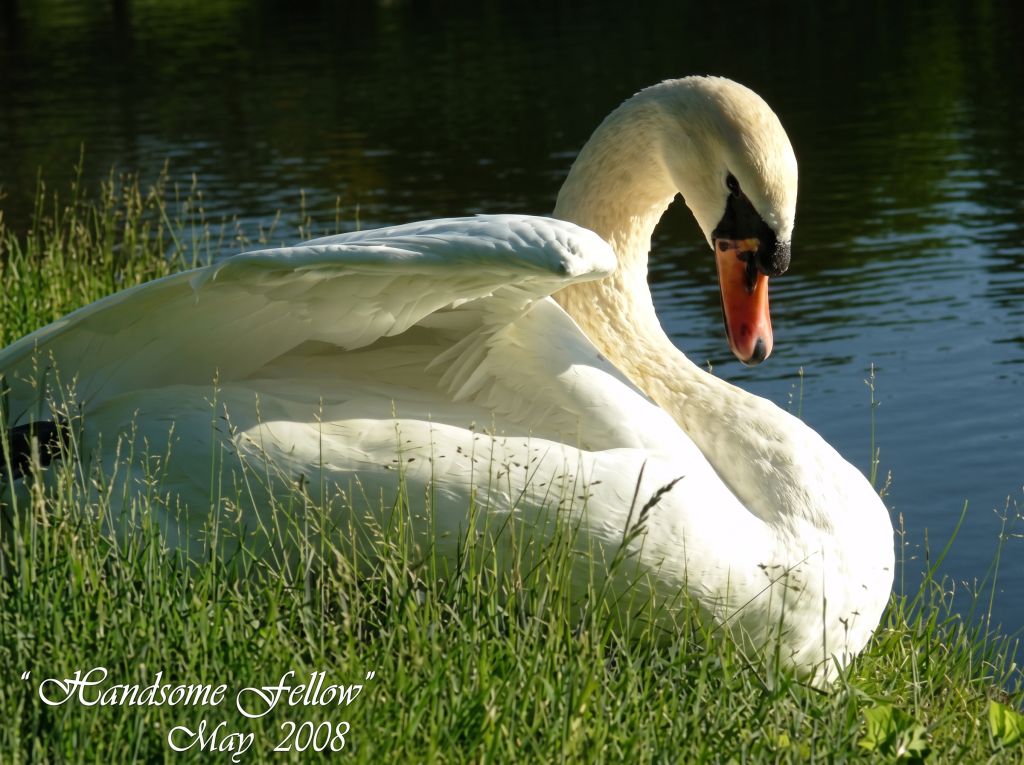
The mute swan is a large, all-white bird, recognized by its orange bill
with black at its base, common in Europe and Asia without any problems
                                                                                    for thousands of years.

The birds grace many lakes and bays in the United States,
primarily on the east coast. Nobody knows exactly when or how the swans
first came to America; however, S. Dillon Ripley, who headed the Smithsonian
and the Birding Department at Yale University, has stated they have been here
                                                                                                           since Colonial days.
How Mute Swans Lost their Protection

Some people are working on proving that they may have migrated with
other swan species from the Russia/Siberia coast across the Bering Straights,
                                                                      just as man did, and at the same time.

There are 9500 year-old fossils of mute swans found in Oregon
and older ones found in Arizona and Idaho. If this can be proved,
it might help win back the birds’ federal protection.

Mute swans can still be found in Russia/Siberia/Kamchatka,
                                                            a short swan flight from Alaska.

The beautiful birds stand squarely in the center of controversy,
as state and federal wildlife officials and some environmental
organizations have been eager to blame mute swans for being aggressive,
pushing out other waterfowl, and even destroying submerged
aquatic vegetation ( SAV ) in sensitive areas such as the Chesapeake Bay.

Problem Mute Swans

They never mention that the SAVs had a worldwide die off in the 1930s,
including our east coast, and the enormous pollution that flows into
the very shallow Chesapeake Bay every single day from chicken and pig farms,
paper companies and unstoppable development on the shorelines has played
a major role in the reason why those grasses are only now returning.

In the northeast, the grasses had returned by the 1970s everywhere
but in Maryland, even though at the time the largest concentration
of mute swans was in Long Island Sound, which had already recovered.
( Maryland has a particular hunting agenda for the swans and
is therefore the most vociferous about their destruction.)
Mute Swan Living Free

The evidence against the swans is flimsy and completely unscientific.
Swans can be aggressive during nesting season, but so are many other
                                                animals and birds – this is natural behavior.

Wildlife agencies’ own studies indicate that the small population of
mute swans – only 3,600 in Maryland and 14,000 in the entire Atlantic Flyway
( 17 Atlantic coastal states the birds fly through in their migration )
 of the United States and Canada – is not causing any real damage.

According to the Chesapeake Bay Foundation, the two leading threats
to the bay’s crucial underwater grasses are agricultural waste run-off from
industrial chicken processing plants ( nitrogen ) and sewage treatment plants.

Mute swans probably wouldn’t make a list of the top fifty threats.
But the big industrial chicken producers pull out all the lobbying stops
to defeat any meaningful attempts to control agricultural waste.
And no one wants to appropriate the money to upgrade sewage treatment capacity.
Mute Swan

It’s much easier for public officials to scapegoat the swans than to grapple
with complex environmental problems. Even in Maryland, where the controversy
has been most heated, the state’s Department of Natural Resources ( DNR )
has repeatedly explained that mute swans have only a “negligible” impact
on the Chesapeake Bay, that “there is no evidence to suggest that mute swans
are causing any impact to agriculture in Maryland,” that the birds “
are not the primary cause of the decline of SAV in the Chesapeake Bay,”
and that, in fact, the “decline of SAV has been attributed primarily to elevated
levels of nutrients and suspended sediments.”

Point in fact: the Chesapeake Bay has never met
                                        the minimum requirements for the Clean Water Act.

Mute Swan


In an ironic footnote to the mute swan saga, the federal and state partnership
 Chesapeake Bay Program recently released a report revealing
the startling news that the upper bay’s underwater grasses have
more than doubled from 2003 to 2004. Which if anything, proves
that the swans have a beneficial impact and not a negative one.
However, they are certainly not promoting this information,
preferring to vilify the swans to accomplish their own ends.

Mute Swan

Origin of the Species?
The “Reform Act” targets not only mute swans, but more than 100 bird species
-including certain species of storks, pelicans, cardinals, cranes, and orioles-which,
according to the new law are not “entirely the result of natural biological
                                                                                                       or ecological conditions.”

But who decides which species meet that arbitrary definition?
That responsibility rests solely with the U.S. Fish and Wildlife Service.

And how do those USFWS decision-makers deal with murky circumstances
such as, say, a species that migrates from its native habitat because
of environmental changes? Are those birds now considered non-native
                                                                                             in their new habitat?

They have already admitted that the mute swans migrate through
the Great Lakes area into the United States. Isn’t that the exact definition
of what the new bill stated? Although the swans were the intended
immediate target of the “Reform” act, other birds will suffer as well.
Some of the species targeted to lose their protection are even considered
imperiled under other international agreements such as
the Convention on International Trade in Endangered Species
                                                              of Wild Fauna and Flora ( CITES ).

Species such as the Nicobar pigeon and the Luzon bleeding-heart
need global cooperation to survive. Bird species protected in other range states
under their domestic laws could be killed when traveling through
the United States, undermining diligent efforts abroad to protect
these same species at other times of the year.

STOP KILLING MUTE SWANs

Sadly, so-called environmental organizations that should have been
on the swan’ side helped the hunters undermine it.

Environmental groups such as the American Bird Conservancy,
National Audubon Society, Sierra Club, The Nature Conservancy,
and World Wildlife Fund should have rallied to the birds’ defense,
but they are little more today than thinly-veiled hunting groups themselves
( The Audubon Society is having a huge internal battle over just this
fundamental philosophical difference.). 

So they joined the NRA, Safari Club International, U.S. Sportsmen’s Alliance,
and Archery Trade Association in the effort to allow
                                                                the wholesale slaughter of mute swans.

This is disastrous environmental mismanagement,
an outrageous political travesty, and abominable and needless potential
destruction of one of the most beautiful animals on this planet,
solely to fit the goals of a diminishing but well-financed hunting lobby
and the federal and state agencies that rely on the sales of hunting licenses to exist.

 Click to Enlarge Images

Discarded Pet Swan
*****************************************************
&&&&&&&&&&&&&&&&&&&&&&&&&&&&&&&&&&&&&&&&
*****************************************************
These Videos Grab my Emotions..
Hard to Watch knowing what is happening to the Mute Swans.
I LOVE Spending Time with Mute Swans.
One Day this may be all we have – The YouTube Videos
******************
Adele Swans Rolling In The Deep
https://www.youtube.com/watch?v=hKldBy2Pd4M
*********************************************
Swan Swimming perfect reflection in tranquil serene Peaceful Pond
Toronto Canada
https://www.youtube.com/watch?v=y1NkmWENsB4
**********************************************
The Life of Swans by Paul Keene
https://www.youtube.com/watch?v=qmXxIA_WoI4
**********************************************
The Regal Swan Fountation – Donations
https://www.youtube.com/watch?v=B9I39ZCIUjE
**********************************************

Mute Swan Shirley Bolin

Information Organized in 2015 by Linda M.Sweger
                                         – PA SwanLover Linda UpDated  July  2026 
********************

An Article by Swan Advocate, Sheila A. Bolin, M.S. CEO
The Regal Swan® Foundation, Inc. PMB 137
7862 West Irlo Bronson Highway Kissimmee, FL 34747
( 407 ) 931-6838 www.theregalswan.com

Salient Points Regarding Mute Swans in U.S.

There has never been an environmental impact assessment of Mute Swans in the U.S.
Most research cited by state and federal wildlife officials is shoddy or non-existent.
Actual valid reliable research which shows that Mute Swans are no more aggressive
than any other species, are not detrimental to the environment and increase biodiversity
                                             is deliberately ignored by wildlife officials

The lack of research regarding Mute Swans was admitted by U.S. state
and federal wildlife officials at the 2014 International Swan Symposium.
Wildlife officials specifically stated that there was no research
when the killing program began under the radar from politicians,
                                                 the media and taxpayers.

Yet, this same shoddy or non-existent research is passed from state to state
and misrepresented to U.S. taxpayers. International swan and wetland
habitat specialists at the symposium disputed the negative claims
by U.S. Wildlife officials regarding Mute Swans, their aggressiveness
                                     and their detriment to the environment.

Fact: The disputed evidence was ignored
                                 by U.S. state and federal wildlife officials.

Current research shows that Mute Swans feeding helps other species
such as dabbling ducks and other waterfowl that cannot reach
                                        below the surface to feed.

There has never been any collaborated count of Mute Swans in the U.S.,
yet state and federal wildlife officials misrepresent numbers to the U.S. taxpayer.

Mute Swans are a ***Sentinel Species which directly disputes U.S. state and federal
wildlife officials claims that Mute Swans detrimental to the environment.

FACT: Mute Swans act as a ***Sentinel species in that they alert scientists
to the presence of high levels of heavy metals such as copper, lead, mercury, etc.,
and harmful microorganisms. Countries such as Sweden, mandate
that scientists immediately test the environment if one Mute Swan dies in an area.

Mute Swans are migratory and was so stated by U.S. Wildlife officials
                                                               in a 2004 Federal District Court.

Scientists are now re-evaluating the claim that Mute Swans are not native
to North America as ancestral Mute Swan fossils have been found in the U.S.

In 1918, the Migratory Bird Treaty Act ( MBTA ) was established to protect
Migratory Birds in Canada, U.S. and Mexico.
                                               Later, Russia and Japan joined the Treaty.

A Federal Court ruling in 2004, specifically stated that Migratory Birds
were protected regardless of native status and Mute Swans were thus
protected and could not be killed or hunted unless
a National Environmental Policy Act Assessment ( NEPA ) was conducted.
To this date, no such environmental assessment has ever been conducted
                                                                        by the U.S. regarding Mute Swans.

In 2004, the Migratory Bird Treaty Act was supposedly reformed.
However, this illegal change to the Treaty was never ratified,
meaning that the Reform Act does not exist. U.S. state and federal
wildlife officials have misled the U.S. taxpayer to believe that they are
killing Mute Swans and other protected birds under the Treaty legally.

In fact, this bogus law has cost taxpayers billions of dollars since 2004.
The U.S. government by not enforcing the MBTA under the original 1918
signing and the 1992 change which was legally ratified is in violation
                                                                              of an international treaty.

In 1992, President Bill Clinton signed with the other member countries
a change to the MBTA which stated that NO SWANS could be hunted
                                  except Tundra Swans by indigenous people of Alaska.

This signage of the MBTA change by all members of the Treaty ratified
the new wording so that only Tundra Swans were to be hunted by
                                                                       indigenous people of Alaska.

This means that since the 2004 Reform Act was not ratified
( signed by the other member countries ), the law does not exist
and anyone ( state or federal wildlife officials, the general public )
cannot legally hunt any swan species in the U.S.
To do so, is in direct violation of the international treaty.

How Mute Swans Lost their Protections
&&&&&&&&&&&&&&&&&&&&&&&&&&&&&&&&&&&&&&&&

The Regal Swan Foundation, Inc. October 26, 2017
“THIS BOGUS LAW IS ONE OF THE LARGEST FRAUDS
     EVER PERPETRATED ON THE AMERICAN TAXPAYER,”

Sheila A. Bolin, CEO, The Regal Swan Foundation, Inc.
Regal Swan® Foundation.


Discovers United States Violating 1918 Migratory Bird Treaty Act:
Federal, State & Local Agencies Have Enforced an Unconstitutional
& Illegal Law, Killing Thousands of Mute Swans Nationwide
                                                                             at Taxpayers’ Expense.

After extensive research, The Regal Swan® Foundation, Inc.,
and its legal team discovered that the U.S. has been violating
the 1918 Migratory Bird Treaty Act ( MBTA ) since 2004,
using an unconstitutional and illegal law titled,
“The Migratory Bird Treaty Reform Act of 2004.”

The Interior Department, U.S. Fish & Wildlife Services,
and the U.S. Department of Agriculture as well as state
and local wildlife agencies, individuals, private companies
and special interest groups, some of whom receive
government grants, have been using this bogus Reform Act
to authorize and circumvent the original MBTA Treaty.

By enacting this fraudulent law, hundreds of thousands
of Mute Swans have been killed nationwide,
using taxpayers’ money to fund this illegal killing program.
“This bogus law is one of the largest frauds ever perpetuated
on the American taxpayer,” explains Sheila A. Bolin, CEO,
                                        of The Regal Swan® Foundation, Inc.

Under the auspices of the Migratory Bird Treaty Reform Act of 2004,
U.S. Wildlife officials and unscrupulous politicians snuck a bill
through Congress under an omnibus appropriations bill
thereby reforming the original Treaty and enacting it into law.

This is highly unconstitutional as a Treaty is a stand-alone
international law instrument, that must be amended and
ratified through the Ratification Executive Committee.

According to Holland vs. Missouri, 252 U.S. 416 ( 1920 ),
the Supreme Court upheld the constitutionality of the MBTA.
Noting that the treaties clause of the Constitution
( Article VI, clause 2 ), sometimes known as the “supremacy clause,”
once a treaty is ratified, it becomes the “Supreme law of the land.”
Meaning that no federal, state or local agencies or governments
may override a Treaty once it has been ratified.

Thus, the MBTA of 1918 was ruled constitutional and
was to be enforced by all federal, state and local agencies.

In another court case, Hill vs. Norton, 275 F.3d ( D.C. Cir. 2001 ),
the U.S. Fish and Wildlife Services was required to recognize
that Mute Swans had, in fact, been protected under the original
MBTA all along, as a member of the Anatidae family and migratory.

The U.S. Fish and Wildlife Services, even admitted
                  at that time, that Mute Swans were migratory.

Under the Reform Act of 2004, not only was the bill originally
sent through the House of Representatives, which is highly
unconstitutional, bills regarding treaties can only go through
the Senate, the reform bill, which became law,
                              was never ratified by the President,
or the other four countries that belong to the Treaty,
to-wit: Canada, Mexico, Japan and Russia.

Using an underhanded ploy to get the bill signed into law,
the bill came out of the Environment and Public Works
Committee of Congress.

Under the treaty process, a bill must come from
the Foreign Relations Committee in the U.S. Senate.
The Reform Act bill was buried in the appropriations bill
and set into law, at taxpayers’ expense.

As such, the Migratory Bird Treaty Reform Act of 2004
violates the Treaty, the treaty process and international law
governing treaties, contracts and agreements.
Since the Reform Act was never ratified, at this moment,
the Act is unlawful, unconstitutional and unenforceable.

Therefore, any entity or person involved in this taxpayer
funded fraud can be held both criminally and civilly liable
for their participation under international law.

In addition, any entity or individual may also be held
civilly liable if class-action lawsuits are brought forth
by taxpayers for restitution of the damage done
while violating both the Treaty and international law.

Under the Obama administration, the Interior Department
and U.S. Fish and Wildlife Services, with the assistance
of the Department of Agriculture, began a campaign
to rid the Mute Swans from across the U.S., using
an arbitrary and capricious method to convince taxpayers
that this swan species was detrimental to the environment.

Current, reliable scientific research as well as international
swan and wetland habitat specialists have disputed
the misrepresentation of Mute Swans by U.S. wildlife officials.

These U.S. agencies and individuals continue to cite
non-existent environmental assessments.

National Environmental Policy Act ( NEPA ),
assessments mandated by a Federal Court in 2004
have never been conducted in the U.S.

These same agencies have introduced Trumpeter Swans
into areas that the swans never inhabited paving the way
to develop a trophy waterfowl hunting program.
The entire time that the Trumpeter Swan program
has been in existence, federal, state and local wildlife officials
assured the taxpayers that these birds would never be hunted.

Last week, federal and state officials stated that the birds
should be allowed to be hunted because hunters could not
distinguish between Trumpeter and Tundra swans.

Tundra swans are also protected under the original Treaty.
U.S. wildlife agencies and officials have allowed and encouraged
hunting across the U.S. of Tundra Swans.

Additionally, the last ratification of the MBTA was in 1992
under President Bill Clinton and specifically stated that
all swan species were protected, and not to be hunted
                                                            except Tundra Swans.

The 1992 ratification allowed Tundra Swans to only
                       be hunted by indigenous people in Alaska.

The 2004 Reform Act was enacted during
                                President George W. Bush’s presidency.

As President Bush was being lobbied to change
the original MBTA Treaty to allow the killing of Mute Swans,
President Bush stated that he was not going to sign
                                                           this bill for ratification.

Therefore, under international law, the U.S. must immediately
cease and desist the killing of all swan species in the U.S.

How Mute Swans Lost  their Federal Protection

The only exception is for the hunting of Tundra Swans
                                                             in Alaska by indigenous people.


&&&&&&&&&&&&&&&&&&&&&&&&&&&&&&&&&&&&&&&&&&